We hear similar stories from most firms we talk to. It goes something like this:
- They bought the platform.
- They got the login.
- The team went through onboarding.
- The vendor sent a customer success manager.
- And six months later, the firm is paying for a product that three people use occasionally and nobody has time to properly configure it.
The people who made the purchase decision weren't wrong about the problem. There are several critical issues for most part that they are grappling with: billing reconciliation that takes 1-2 weeks, the data across systems goes out of sync, compliance prep eats a full week before every exam. So, the problem statements were all correct. What they bought just wasn't the solution.
The tool trap
Financial services firms have been conditioned to buy tools. CRM, PMS, compliance platform (and sometimes have outsourced compliance officer), custodian portal, planning tool, and document management system. Each one solves a narrow problem and each one requires your team to learn it, configure it, maintain it, and connect it to everything else.
AI has inherited these buying patterns as well. Firms go shopping for "an AI platform" the same way they went shopping for a CRM in 2015. They evaluate features, compare seats, negotiate a contract, and hand it to their team. The assumption is that the team will figure out how to make it work for their specific workflows.
Most teams don't. Not because they're incapable, but because they're already running the firm. No one has three weeks to sit with a new tool and figure out how to wire it into the six systems it needs to talk to. Nobody has the spare cycles to define every rule, threshold, and exception case that makes the difference between output you can trust and output you have to re-do.
So the tool sits there. Live but practically underused. The license renews. The problem it was supposed to solve is still being solved the old way. No changes, no ROI.
What buying an outcome looks like
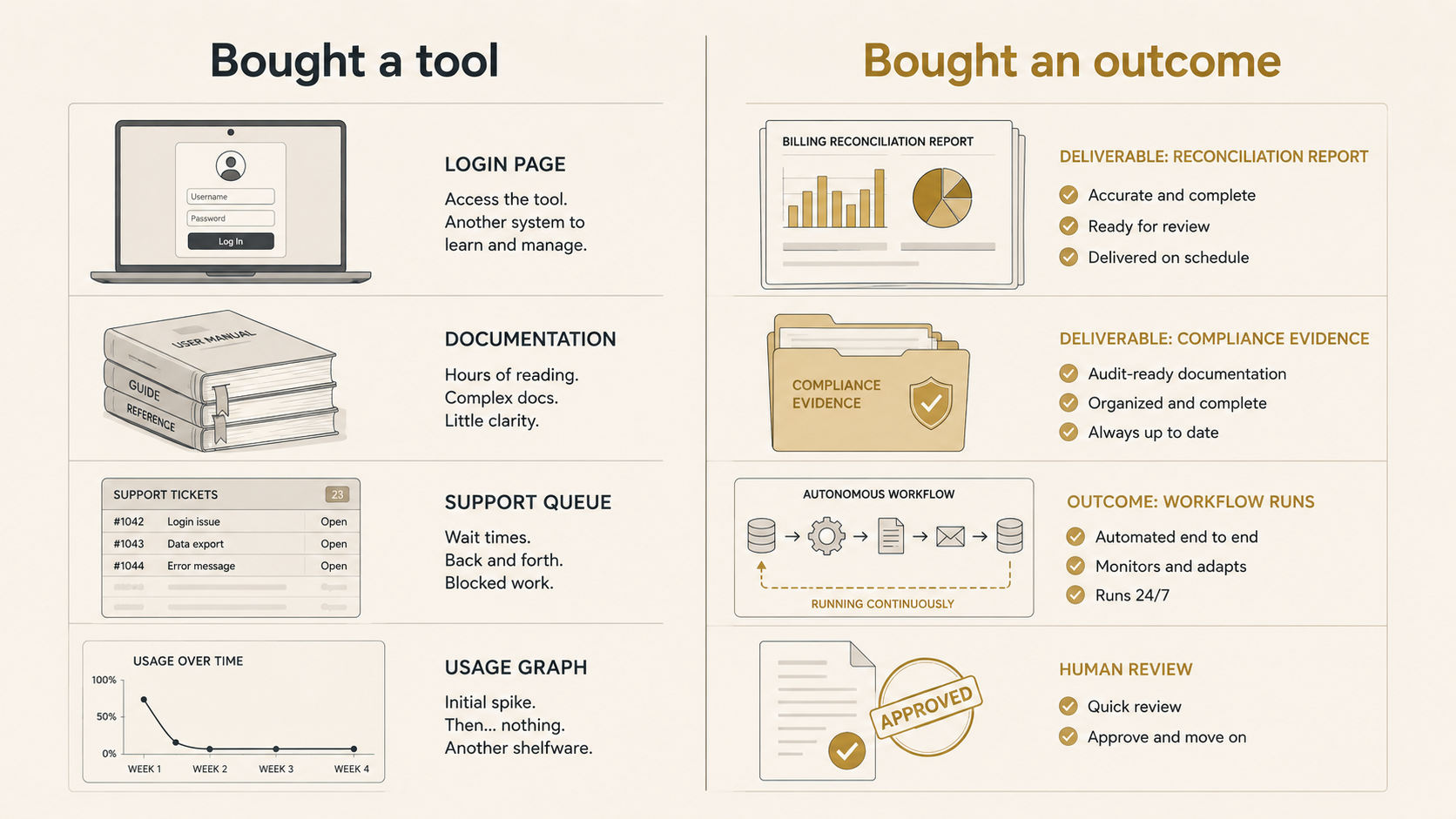
The opposite of buying a tool is buying a result. You don't want a platform for fee billing reconciliation. You want your fee billing reconciled, across every account, every cycle, with discrepancies flagged and a corrected file ready for submission. You don't want a compliance monitoring dashboard. You want your IPS compliance checked against every client portfolio, with drift flagged the moment it happens and evidence logged automatically.
Does that sound like the same thing but said differently? It is not though. When you buy a tool, the burden of making it work stays with your team. When you buy an outcome, the burden shifts to whoever sold it to you. They have to understand your systems, your rules, your edge cases. They have to make it work against your actual data, not just show a fancy demo. And they have to prove it produces the right answer before anyone calls it done.
Most vendors stop here. They'll show you the demo, walk you through the setup wizard, and hand you documentation. Getting from there to a workflow that actually runs in production against your real data, with your firm's specific rules, producing output your compliance officer trusts... that's where most AI purchases go to die.
Why the industry defaults to tools
There's a reason the tool model persists. Vendors can sell at scale. One product, many customers, same onboarding deck for everyone. It's efficient for the vendor. It just isn't efficient for the buyer.
The buyer's workflow is specific. Every firm has slightly different fee structures, slightly different approval chains, slightly different interpretations of what a "discrepancy" means. The tool can be flexible enough to accommodate all of these in theory. In practice, configuring it to match your specific rules is itself a project that nobody has bandwidth for.
The result is that most firms end up using maybe 20% of what they bought. The platform can do 50 things. They use it for 3. The other 47 require configuration work that never happens. The vendor calls it "adoption" when the real issue is that the product was never fitted to the firm.
How to tell which one you're buying
There's a simple test. Ask yourself who does the configuration work. If your team has to build the workflows, set the rules, connect the systems, and define the logic, you bought a tool. If someone else does that work against your actual data and processes, you're closer to buying an outcome.
Then ask what happens when the output is wrong. "Submit a support ticket" means you bought a tool. "We tune it until the output matches your team's judgment" means you're buying an outcome.
And look at what's actually running 30 days after you signed. A login your team accesses when they remember to is a tool. A workflow that runs on its own, flags what needs attention, produces evidence, and only involves a person when a decision is needed, that's an outcome.
What this means for how you evaluate vendors
The next time someone pitches your firm an AI solution, don't ask what it can do. Ask what it will have done 30 days after you sign. Ask who configures it to your specific rules. Ask what "live in production" means to them. Ask whether your team needs to do anything after go-live for the workflows to keep running.
The firms we work with didn't want a platform to explore. They wanted their billing reconciled. Their data in sync. Their compliance evidence produced as a byproduct of the work itself, not assembled manually before an exam. The output was the purchase, not the software.
That's the shift. Stop buying things your team has to operate. Buy things that produce the result you actually wanted when you signed the check.
What we built at PitCrew
We built PitCrew around the idea where a PitCrew expert embeds with your firm for 5 working days. They map your workflows, connect your systems, configure AI agents to your specific rules, and calibrate until the output matches your team's judgment. Then they leave. The platform keeps running the workflows on its own.
You don't get a login and a support number. You get billing reconciled, data in sync, compliance evidence produced automatically. The outcome is the product.