Every wealth manager we talk to has the same story. They've started using AI. Claude for research. ChatGPT for drafting. A notetaker. Maybe a dedicated AI or a copilot bolted onto their CRM. A portfolio management software with the built in AI.
Each of these tools works well in its own garden. Claude and ChatGPT know about the world but not your firm knowledge. The notetaker captures your meetings. The CRM's AI knows your contacts. The portfolio management platform's AI knows your holdings. Individually, they're fine, but a wealth manager's job doesn't live on a single platform.
A client calls about rebalancing ahead of a Roth conversion. That touches your CRM for relationship context, your custodian for account data, your portfolio system for current allocations, your calendar for scheduling, and your compliance records for documenting suitability. Five systems. Five separate AI tools that know nothing about each other.
Your team already knows this pain. They spend hours every week stitching data together manually. Copying between screens. Re-entering information. Briefing each other on what lives where. The AI was supposed to reduce that work. Instead it added another set of tools to keep on top of. The firm adopted AI, but the AI is walled off, so it can't actually help them.
Why One AI Can't Do It All
The obvious next step: plug all your systems into one AI and ask it anything. Give Claude access to your custodian data, your CRM, your PMS, your billing files, and just talk to it. Sounds right. Doesn't work.
Data overload
You wouldn't ask one person on your team to simultaneously manage every client's portfolio, CRM records, compliance docs, billing, and calendar. They'd drop the ball within a day. AI has the same problem. It's not about how smart the model is. It's about how much you're asking it to remember at once.
Connect five systems to one AI and start asking questions. At first it seems to work. Then it starts mixing things up. Client names get swapped. Account details that don't exist show up in responses. It cites conversations that never happened. Now you're spending time verifying the AI's work instead of doing your own.
Your firm has specialized people for the same reason. One person can't hold the full context of every system and every client and work across all departments. AI models have the same limitation.
Connection doesn't mean action
Even when systems talk to each other, their AI tools don't act across the board. Your CRM's AI can't rebalance a portfolio. Your portfolio platform's AI can't work with your billing spreadsheets. Your general-purpose ChatGPT can't execute anything on your custodian platform.
You end up with AI that can read some things but do nothing with them. You're still the middleman between all of it.
Your systems don't agree with each other
Your custodian says a client's portfolio is worth $2.14M. Your portfolio management system says $2.09M. One system has the client's risk tolerance as Moderate. Another says Conservative. Your CRM says the last sync was 12 days ago. These discrepancies exist today. Your ops team catches them manually, reconciles by hand, and moves on. It takes time but at least a human notices something is off.
Now dump all of that into one AI. It doesn't flag the conflict. It just picks one number and runs with it. Or worse, it blends the two and gives you a figure that exists nowhere in your records. You asked for an answer and got one. It just happens to be wrong, and nothing told you so.
Existing platform AI can't solve this either. Each system's AI trusts its own data. The custodian's tools assume the custodian's numbers are right. The CRM's tools assume the CRM's numbers are right. Nobody's job is to look across both and say "these don't match, here's why, here's which one to trust." That job falls on your team. Every time. Yet again: the firm is using AI, but isn't seeing any of the benefits.
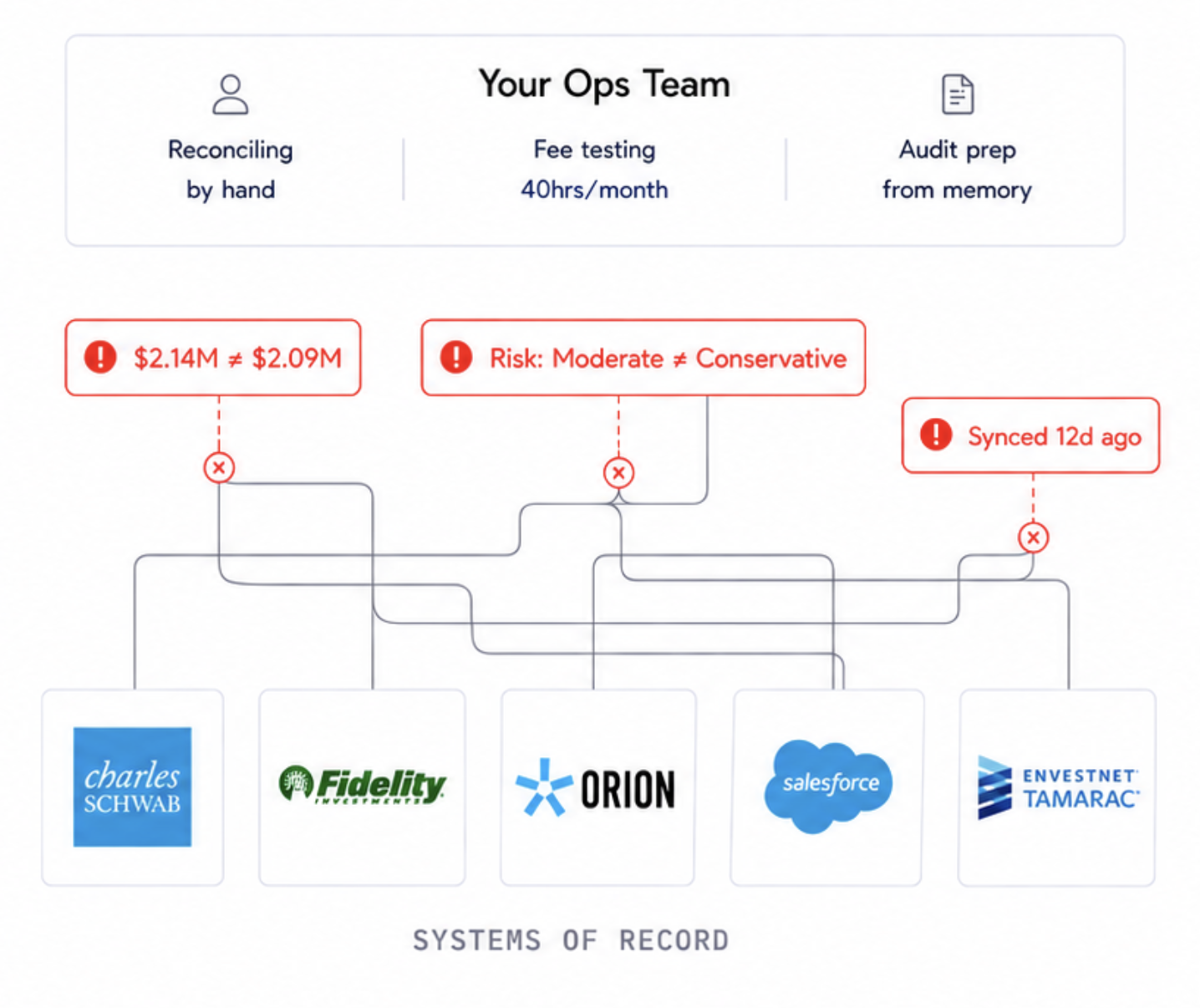
The Problem Isn't Connection. It's How You Connect.
Most firms we talk to think this is just how it is. AI can only do so much and not more. That's not the case.
The problem isn't that your systems shouldn't be connected. They absolutely should. The problem is dumping everything into one model and hoping for the best. That's not a connection strategy. It's a mess with a chatbot on top.
What works is an intelligence layer that understands each system independently. When a task needs portfolio data, it pulls from your portfolio system. When it needs client context, it pulls from your CRM. When it needs to check a fee, it looks at billing. It doesn't try to hold everything in its head at once. It knows where to look, what to pull, and what to do with it.
Then it acts. Not just reading your CRM, but updating your portfolio notes, flagging a compliance issue, drafting the follow-up email. You stop being the glue between four tabs.
And in a regulated industry, every action needs a paper trail. What was read? What was decided? What was changed? Why?
Where PitCrew Fits
PitCrew is the orchestration layer across your existing systems of record.
Your systems stay exactly where they are. Schwab, Fidelity, Orion, Salesforce, Tamarac. We don't replace them. We sit between them and handle the data plumbing that your team currently does by hand. We build AI agents that connect to the systems your firm already uses, work across them the way a team member would, and remain fully auditable. Every decision, every action, every source, documented. Your team stops reconciling by hand. They review exceptions instead.
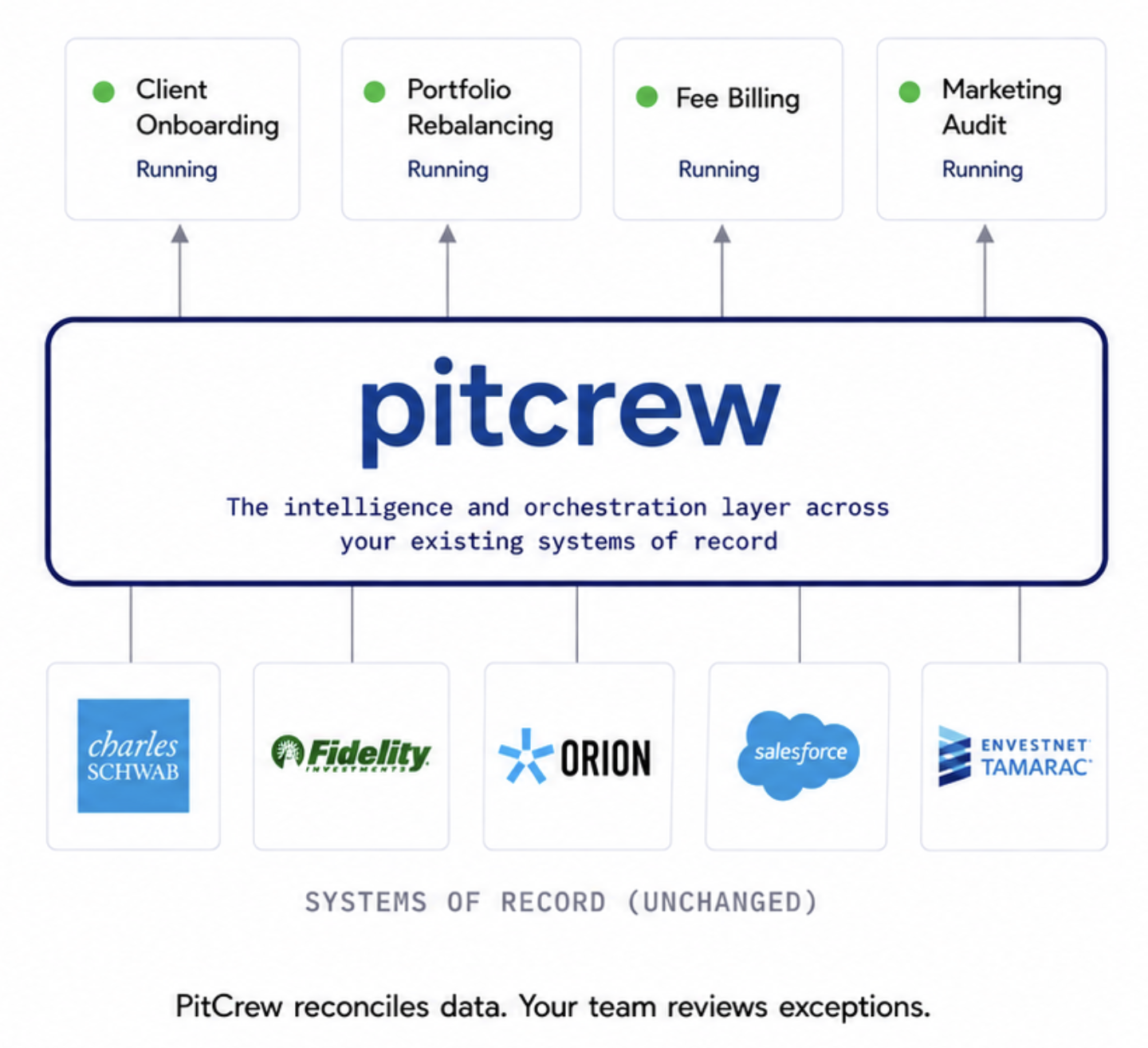
We've spoken to wealth managers across the industry and gotten the same feedback. Once the AI can actually work with your systems instead of just sitting next to them, the promise starts matching reality.