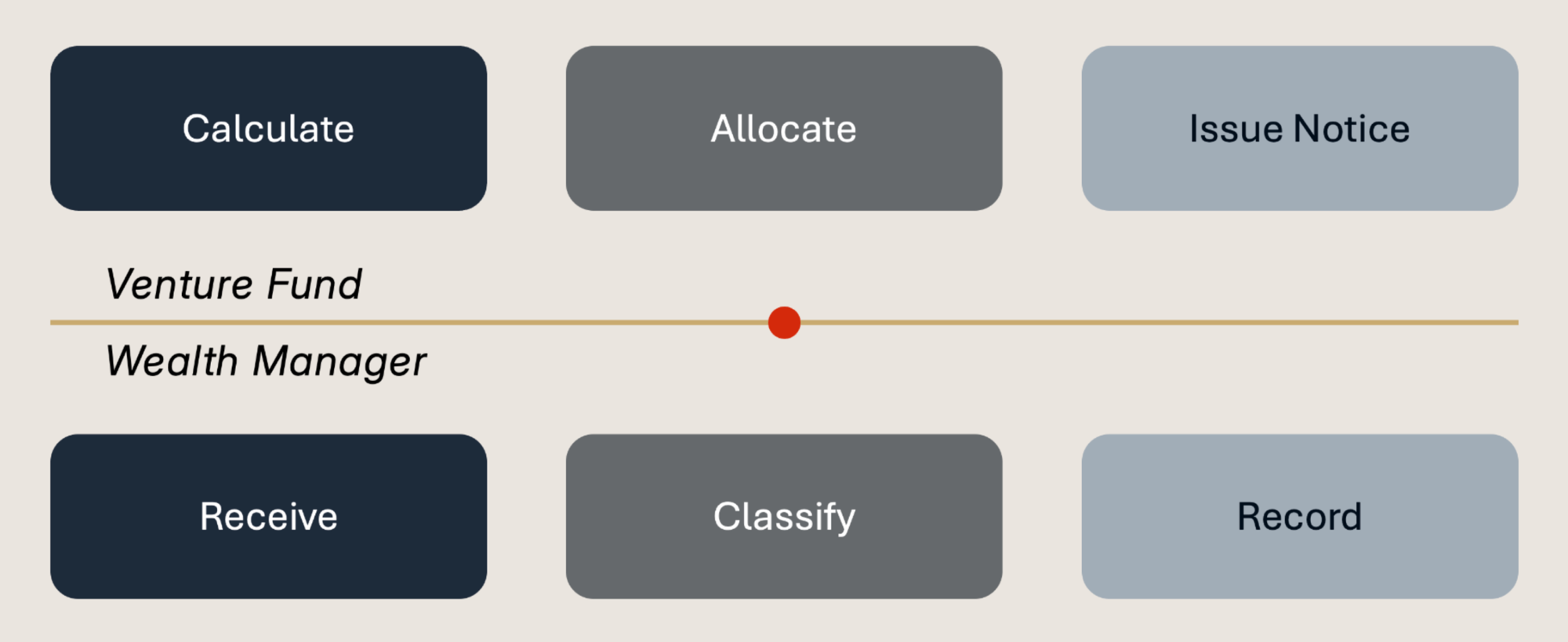
Strip away the letterhead and a capital call is a single economic event: a General Partner (GP) asking a Limited Partner (LP) to fund a commitment. Generation of that PDF on the venture fund side and consumption of that PDF on the wealth management side are two entirely different operational problems.
On the fund side, the notice is the output of a chain of accounting decisions: how much to call, from whom, blended with what fees, adjusted for what side letters.
On the wealth management side, the same notice is an input that has to be read, understood, and correctly recorded before anyone downstream can trust a performance number or a tax return.
Equalization, expense allocation, multi-entity structures. All done by hand, under deadline pressure.
Miscoded transactions, wrong distribution splits, performance metrics built for the wrong asset class.
Both sides end up as manual grunt work that drains the operations team. AI agents can change that on both ends.
The Fund's Problem: Getting the Math Right, By Hand
Most venture funds don't fail at capital call math because the math is exotic. They fail because the software underneath the math was never built for it.
The most common breakdowns, roughly in order of how often they surface:
No native concept of an LP capital account. General ledger software built for small businesses has no object for "unfunded commitment" or "paid-in capital." Every fund tracking this in a spreadsheet parallel to its books is one version-control mistake away from a call notice that doesn't match its own ledger.
Expense allocation done by hand, invoice by invoice. A single legal bill needs to be split across a fund, a co-invest SPV, and a parallel vehicle, using rules the LPA dictates but no accounting system enforces. The SEC has made exact adherence to LPA-defined allocation methodology an examination priority, and has fined advisers for shifting or misallocating fund expenses without disclosure. A manual, invoice-by-invoice process is hard to defend line by line when an examiner asks for it.
Equalization math that compounds with every subsequent close. New investors joining after an initial close have to be folded in as if they'd been there from day one. They need to pay their share of historical calls plus interest, and catch up on management fees at their own negotiated rate, not a blended average. By fund III or IV, this is a genuinely hard calculation, done in Excel, under time pressure, right when a large wire is due.
Multi-entity structures that fight the software. A fund manager running a flagship fund, two SPVs, and a continuation vehicle is running four sets of books that all need to talk to each other. Most accounting systems make that a login-and-logout exercise between separate company files. Per Carta, the annual count of new SPVs formed has grown 116% over the past five years, so the number of funds running this exact problem is growing, not shrinking.
Fund controllers and operations teams know exactly how equalization interest should be calculated. The tools force every calculation into a spreadsheet, and spreadsheets don't scale with fund count, LP count, or vehicle complexity. They just get more fragile.
The Wealth Manager's Problem: Reading Someone Else's Homework, Fast
On the receiving end, the wealth manager's operations team has a different problem: none of what the fund just calculated arrives as data. It arrives as a document.
There's no data feed for private markets. Public market custodians push structured buy/sell/dividend data straight into a portfolio system. Alternative investments arrive as an emailed PDF, a portal download, or sometimes a scan, with a different format for each GP and no two alike.
Capital calls get miscoded as purchases. A capital call isn't a new investment decision; it's the conversion of an existing commitment into paid-in capital. Legacy portfolio systems built for public securities lack the ability to distinguish capital calls from standard purchases, recording them as generic "buy" transactions. This inflates the cost basis and obscures the true unfunded exposure.
Distributions get miscoded as gains. A single distribution notice can carry a return of capital, a recallable amount the GP can call back later, and real income. That's three different tax and accounting treatments bundled into one number. Treat it all as a generic gain and the client's cost basis is wrong, their future liquidity need is invisible, and nobody notices until the fund exits.
Performance reporting compounds the damage even when classification is correct. Legacy portfolio systems default to time-weighted return (TWR), the right measure for public securities where the manager doesn't control cash flow timing. Venture capital needs money-weighted return (IRR) because the GP controls exactly when capital is called and returned. A system defaulting to TWR will make a healthy young fund's fee-heavy early years look like a loss, regardless of how clean the underlying data is.
This is the default outcome any time alternative investment data lands in a system that wasn't built to distinguish "this cash is a purchase" from "this cash is a commitment being funded."
Where AI Agents Actually Help
There's real, mature technology already addressing pieces of this: document extraction tools that read GP PDFs and push structured data downstream, and portfolio systems purpose-built to handle unfunded commitments and distribution types correctly once they receive good data. What none of that tooling does, by design, is cover every gap in the chain.
The practical question isn't "how do we replace the document." It's "what do we do about the seams around the document, today, with the tools already in place."
The realistic opportunity is AI agents that sit alongside the existing accounting system, portfolio system, and extraction tooling a firm already trusts, picking up exactly the work that falls between them.
On the fund side:
- Independently recalculating equalization interest and management fee catch-ups against the LPA's actual hurdle rate and day-count terms, flagging any variance from what a spreadsheet produced. A second set of eyes on a calculation currently done once, under deadline pressure, with no automatic check.
- Reading multi-line invoices and legal documents to apply LPA-based expense allocation rules consistently across funds and SPVs, instead of a controller doing it invoice by invoice.
- Tracking side-letter terms (MFN clauses, fee discounts, recycling rights) as machine-readable facts rather than institutional memory scattered across PDFs and a paralegal's inbox.
On the wealth manager side:
- Classifying what a distribution or capital call notice actually contains (separating principal from fee from equalization interest, return of capital from recallable capital from income) before any of it reaches the portfolio system.
- Watching cash readiness against upcoming calls across every client and every fund relationship, catching the liquidity gap before it turns into a forced sale or a missed deadline.
- Turning every reconciliation and exception resolution into a timestamped record, so the evidence an examiner eventually asks for already exists instead of needing to be reconstructed from memory and email threads.
None of this requires new infrastructure or a new system of record. It requires a layer that reads what today's documents and today's systems already produce, catches what a human would otherwise have to catch by re-deriving the math or rereading the PDF, and leaves a trail behind it. The operations team stays in the loop on every judgment call. The agent's job is to make sure the right judgment calls actually reach them, instead of getting buried in a stack of PDFs or trusted at face value because nobody had time to check.
We spend a lot of time at exactly this intersection: fund administration meeting wealth management, GP meeting LP. Whether you are a wealth manager struggling with ingestion or a venture fund battling allocation math, let's talk about where AI agents can close the gaps in your specific stack.