Every firm in financial services is hearing that AI is the growth lever they're missing.
Our team has sponsored multiple large conferences this year. We've talked to over 100 firms at various stages of AI adoption. Most of them started because of something they heard, something they saw at a conference, something a competitor appeared to be doing. The pattern after that is remarkably consistent. The first few weeks feel like magic. Then the cracks appear. The AI is genuinely impressive. The distance between "this works in a demo" and "this works for my firm at scale" is just far wider than anyone expects walking in.
The pressure builds fast and the instinct is natural. If everyone else is doing it, we should too. The tools to build with AI are right there. Claude, ChatGPT, Cursor, off-the-shelf APIs. The barrier to entry has never been lower. The best way we at PitCrew found to describe it: AI today is a genie in a bottle. It grants wishes exactly as stated. But without control over the genie, without understanding how it interprets your prompts, without visibility into what it assumes, those wishes backfire.
Based on these 100+ conversations, the PitCrew team observed that firms make three wishes to AI. All reasonable. All granted. All eventually problematic.
Wish 1: Reduce time on grunt work
The first couple of days with any chatbot solution feel like hiring a brilliant assistant. Meeting notes get summarized in seconds. Research that took an afternoon happens in minutes. Slide decks materialize from bullet points. You see the time savings immediately and think, why didn't we do this sooner?
Then the organizational debt starts accumulating. You need to keep reminding the chatbot that some conversations are only for email analysis while others are for presentation prep. Preferences bleed across contexts. The chat list grows into a graveyard. Which thread had the notes on that key account? Which one had the meeting prep for the prospect call last Tuesday? You're now spending time managing the tool that was supposed to save you time.
Then come the limits. You need to query something urgent before a client call, but you've hit the usage ceiling. Pay more or wait three hours. Your team hits the same wall. Multiply that friction across five, ten, twenty people, and the cost-to-limitation ratio stops making sense. The tool that felt free now has a tax. In dollars, yes, but also in workflow interruptions at the worst possible moments.
Wish 2: Build customized solutions for our firm
Maybe you heard about a competitor who "vibe-coded" something over a weekend. A slick internal tool built by the tech-curious person on the team using one of the frontier models. The story sounds great. And it makes your current vendor spend feel overpriced for what it delivers.
So your firm tries the same. And the prototype does come together fast. A bot that handles a specific workflow, a dashboard that pulls from your CRM, a document generator tuned to your firm's templates. The weekend demo gets applause.
Then Monday arrives.
The demo lives on one person's laptop. Getting it online becomes its own project. Hosting, authentication, security flags, data handling. The team that was supposed to benefit from the tool is now maintaining the tool. Every model update risks breaking something. Every edge case requires someone to debug prompt logic instead of doing their actual job.
And the bill comes in layers. Hosting costs. Storage. Model credits, for running the tool and for the dozens of iterations it took to build it. You paid the model companies. You paid in engineering time. You paid in opportunity cost. Every hour spent maintaining an internal tool is an hour not spent growing the business.
The firms that went down this path aren't necessarily worse off. But very few are seeing the growth they were promised. The tool works. It just isn't working for them.
Wish 3: Let me work with my data
This is where the frontier models shine brightest, and where the failure mode is most dangerous.
Upload spreadsheets, feed in meeting transcripts, hand over PDFs. The AI processes everything, cross-references, finds patterns, generates reports. If you're a small firm, it feels like gaining an entire analyst for $200 a month. Reconciliation that took days now takes minutes. Research across documents that used to require a dedicated person happens in a single prompt.
Then you look closer.
An asset value rounded up when it shouldn't have been. A client relationship inferred from proximity in a document rather than actual data. A meeting outcome described that never happened. The AI filled a gap with something plausible instead of flagging it as missing. These errors don't announce themselves. They hide in the sea of otherwise competent output, buried in paragraphs of confident-sounding analysis.
Now you're checking everything with a microscope. The trust contract is broken. It breaks across the board. The AI hallucinates and fills gaps with plausible-sounding answers instead of flagging what it doesn't know. In financial services, plausible is not the same as accurate, and the difference is compliance exposure.
The security perimeter becomes unclear. Client data fed into a general-purpose model may be stored, indexed, or used to improve future responses. Nobody at the firm agreed to that when they uploaded the spreadsheet. The confidentiality obligations your firm carries don't travel with the file. Company guidelines don't travel either. The AI doesn't know what's compartmentalized, what requires a compliance review before going out, what can't be discussed across client accounts. It optimizes for a good answer, not a permissible one.
When you catch an error and ask the AI to fix it, it over-corrects, changes things that were right. Introduces new issues while addressing the one you flagged. You're back at the beginning, having spent more money and more time than if you'd just done it manually.
The data capabilities are real. Data accuracy in financial services is the baseline. A tool that's right 95% of the time sounds impressive until you realize the 5% can trigger compliance issues, erode client trust, or cost you hours verifying what was supposed to be verified for you.
The genie granted every wish as asked
The grunt work got reduced, until organizational chaos ate the savings. The custom solution got built, until maintenance became its own workload. The data got processed, until the errors required more oversight than doing it by hand.
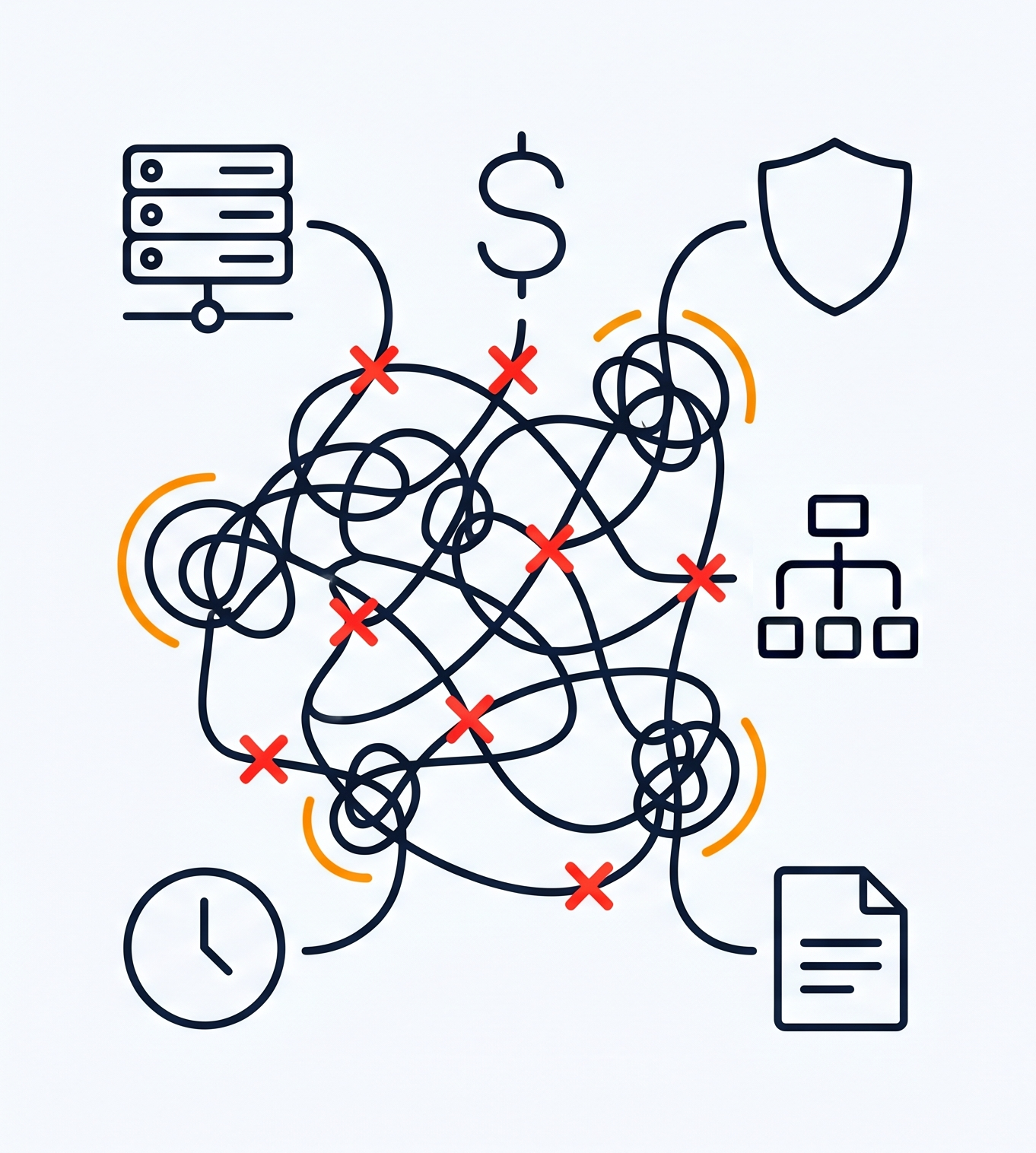
This is the pattern we keep seeing. Firms react to the narrative pressure, build fast, hit walls, and either scale back or spend more time managing AI than doing their actual work. The problem was never the AI itself. The problem was deploying it without the infrastructure to make it reliable.
So what separates the firms that are quietly getting real results from the ones stuck in this cycle?
The Genie, Managed
If only while asking for the wishes, you had someone who knows what you actually want, who knows exactly how the genie will shortchange you, and what the hidden costs of each interpretation are.
That's what purpose-built external AI tools do. They protect your team from the failure modes that every firm eventually discovers on their own.
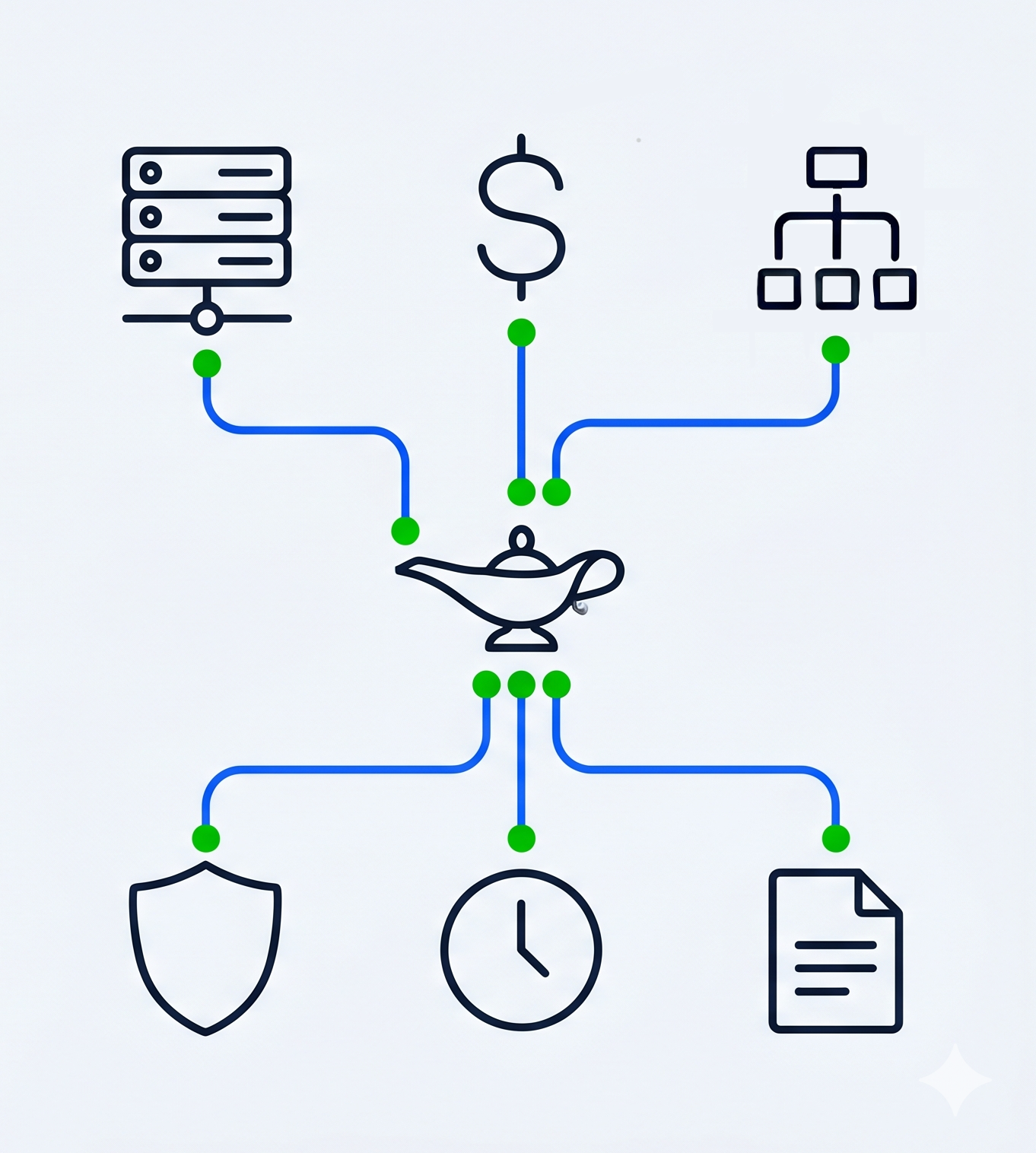
Within the last year, financial services has seen a wave of AI companies built specifically for how this industry operates. Solutions designed from the ground up around the constraints that matter:
Stability in a moving landscape. New models release monthly and each generation is meaningfully better than the last. Purpose-built platforms absorb every update and test against your existing workflows before anything changes. When a better model ships, your account reconciliation runs faster, your report generation gets sharper, your compliance checks catch more, without anyone on your team touching a thing. The compounding improvement happens in the background.
Regulatory awareness baked in. Your team moves at full speed because the guardrails are structural, not behavioral. Client data stays inside your perimeter. Firm data never touches a model that trains on it. Nobody has to stop and ask whether this upload is okay, whether this prompt crosses a line, whether legal needs to review it first. The system answers those questions before they're asked, so the people doing the work never have to slow down to ask them.
Human-in-the-loop by architecture. The AI handles everything it should handle automatically: pulling data, drafting outputs, cross-referencing across systems. The moment something needs a human, it stops and waits. Your advisor sees a clean output ready for sign-off, not a pile of raw AI output to sort through. Every decision is logged. Every output is auditable. The firm stays in control without anyone spending time being the control.
Cost predictability. Your firm knows what AI costs before the month ends. Workflows scale up without the bill becoming unpredictable. You can run the same process across fifty clients or five hundred and the economics stay proportional. AI becomes a line item you manage, not a variable your finance team watches nervously.
Expertise to build sustainably. You get a platform shaped by what's worked across dozens of firms before yours: which workflows compound value over time, which ones plateau, where the organizational leverage is highest. That means your first workflow isn't a learning exercise. It's already tuned for firms your size, with your tech stack, running processes like yours. You start at the other end of the learning curve.
Build vs. Buy checklist
Not every AI problem is a buy problem. A simple task with one tool, one user, and one output can often be built and maintained without much overhead. A single advisor automating their own meeting notes with a general-purpose tool? That works. The economics make sense. The failure modes are controlled and manageable.
The math shifts the moment a workflow crosses boundaries. Multiple systems. Multiple people. Outputs that touch compliance, client data, or firm-wide processes are the ones where building a solution becomes chaotic. Connecting Schwab to Salesforce to Orion, with outputs reviewed by compliance and actioned by an advisor, requires full-blown orchestration, not just automation. While managing this orchestration is a challenge in itself, in-house code compounds that challenge 100-fold.
Three questions worth asking before deciding whether to build or buy:
Is failure expensive here?
If the task touches client data, compliance, or anything that gets reviewed, the cost of a bad output goes across time as well as exposure. These are the workflows where guardrails and auditability earn their keep. Build solutions will largely not tackle the guardrail and auditable records well. Various options in the market have solved for this in multiple ways for multiple firms.
Is AI getting very good at this, fast?
Some tasks are becoming nearly free to automate: content, data formatting, routine summarization. When accuracy keeps improving and results can be obtained cheaply through a purpose-built vendor, maintaining your own version stops making sense. You're paying to keep up with the ever-changing AI world, which improves your efficiency in the background without you touching anything.
Does this need to capture organizational learning?
Some workflows get smarter with repetition: client preferences, firm-specific language, edge cases your team has seen before. A general-purpose chatbot resets every session. A purpose-built system builds institutional memory, and that's where the compounding value comes from. Most build solutions focus on solving a problem at a single point in time.
What we're building at PitCrew
We watched this cycle play out dozens of times. Firms reacting to the hype, building internally, hitting the same walls, and either scaling back or spending more time maintaining tools than using them.
PitCrew exists to be the layer between your firm and AI's complexity. We handle the orchestration: connecting your systems, managing the models, enforcing compliance guardrails, keeping humans in control. Your team gets the growth that AI can actually deliver when the infrastructure is right.
The firms getting real results from AI aren't the ones who built the most. They're the ones who recognized that running a financial services business and running an AI infrastructure company are two different jobs. And they chose partners who handle the second one.