Sameer Goel, Ramesh May and I have spent over a decade building and scaling software led businesses. We operated in a broad software category called System of Record (SoR), a central repository designed to store business data (customer info, employee records, or vendor contracts). We designed user experiences over these system of record which were opinionated (this is the only way you access customer data or this is right way to collaborate on a contract). These designs forced job functions like Sales or Marketing or People Ops to revolve around the silos of CRM or ERP or HRIS.
For us the UX was the product. We created stickiness by enforcing data hygiene, promoting shared vocabulary and training muscle-memory around the usage of the product. We always assumed that the glue that connected these silos of systems of record is the human element. We saw first hand that organizational structures being built or evolve specifically to manage the boundaries of these static systems. (we are not proud of the frictions at these boundaries!)
What made building business software hard was the maintaining of the workflows and scaling of the data model. These got harder over time as we had to solve for collaboration-based edge cases in growing organizations. New team or experts would bring in new requirements for approvals, governance, interactions, or newer systems of records. If we were to pin point one single thing which broke the camels back of business software: it was building and maintaining workflows.
That changes now with AI Agents.
Based on the battle scars we have building business software we believe AI agents will redefine the need for human gatekeeping ("collaboration") between systems of record. AI agents act as navigators that transcend silos, guided not by rigid data model or opinionated workflows but by intent, goals, and guardrails. Unlike traditional software, AI agents stitch together context on the fly, accessing the specific records they need across multiple systems, and apply language model reasoning to deliver an outcome. This shift makes the legacy boundaries of SoR redundant (strong opinions in workflows don't matter) as the agent focuses on the completion of the objective rather than the management of the record. Gatekeeping now focusses on the guardrails and outcomes.
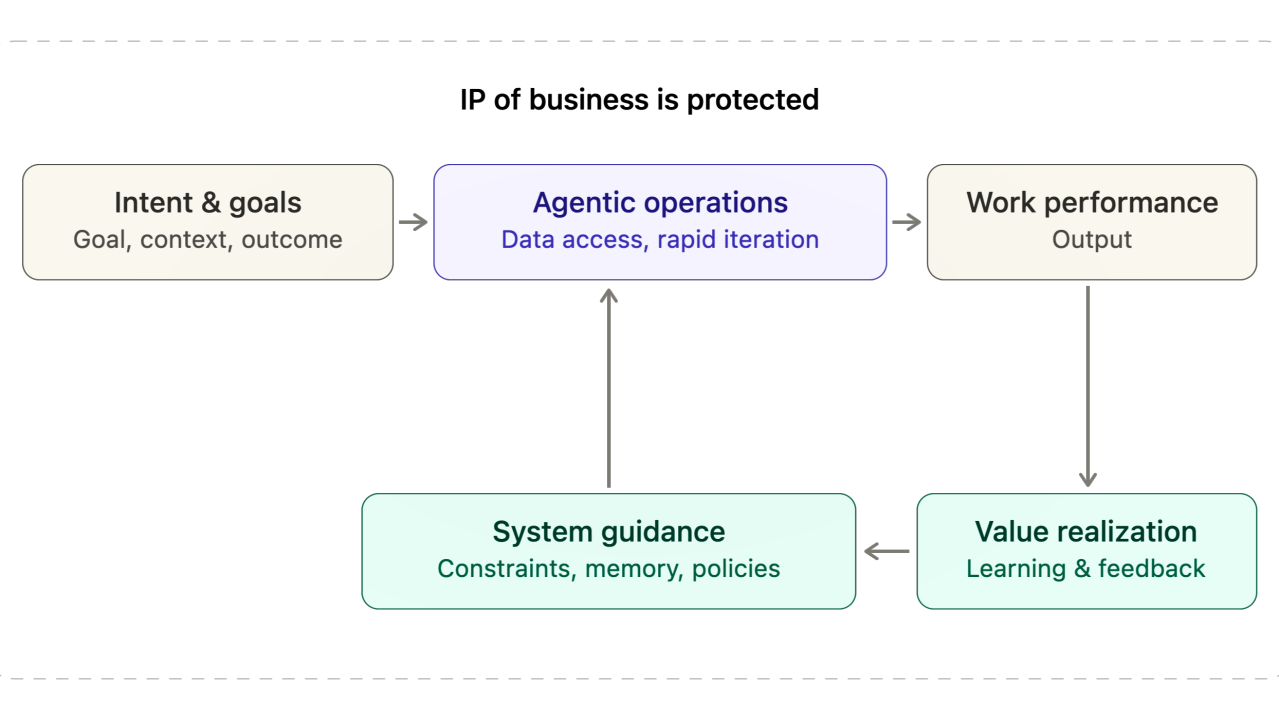
Intent is to the system of work what data model is to the system of record. If the two key pillars of business software were: Data model and Workflows then the key pillars of System of work are: Intent, Goals and Guardrails.
We at PitCrew have designed and build a harness platform that can be configured to suite the goals environment, we enabled a intent capture system that guides the user to define the intent and guardrails. We have agent execution environment which complies to the guardrails and delivers measurable outputs. The outputs are then verified against specified goals.
The idea of intent is not new, it's like specifications or SoP's. But communicating Intent for agents is not intuitive, in fact large models make it hard (perhaps by design to drive excessive token usage). Agents need to know the jobs to be done but also need to be made aware of the guardrails. Unlike human work, agents could claim goals achieved as judged by AI models, but the as judged by humans it could fall short, as judged by governance lens they can definitely mess up. The goals measuring systems need rubrics, evals and loops which ensure the goal is really achieved. Goal systems also ensures Agents operate within guardrails configured through governance policies, training loops, IP boundaries, compliance demands.
Looking back at the systems we've spent the last decade building, we see the limitations of the boundaries we once defended. Looking forward, we see the potential for something far more dynamic. As builders, our role is evolving: we are no longer just the architects of data, but the stewards of intent. It is time to leave the frictions of static systems behind and embrace a future where our software is as adaptable and intelligent as the people it serves.
This article was originally published on LinkedIn. Read it on LinkedIn →