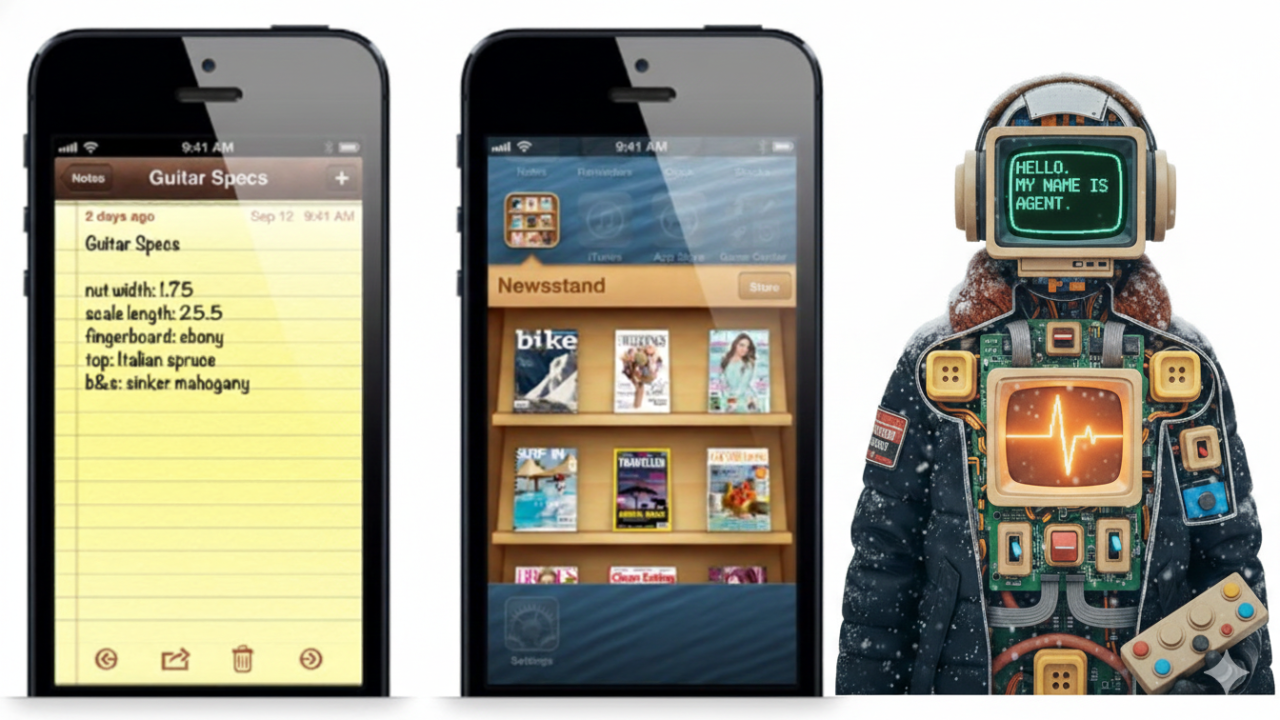
AI on Rails part I and later part II expanded on standardization of agents, providing the tools and protocols necessary for smooth, fast, and reliable agentic developement and operations. A set of conventions, integrated primitives, and opinionated defaults that let teams build agentic systems without reinventing coordination infrastructure. This time we will tease out UX elements for these agentic primitives.
Skeuomorphism as an AI Adoption Strategy
Very interestingly a pattern can be observed in the agentic tooling landscape. The coordination primitives for agents need not be invented from first principles, they can be borrowed from human organizational systems:
- Agent Kanban gives agents a kanban board for parallel work.
- Agent Mail gives agents email-like inboxes and outboxes.
- Agent Tickets give agents structured project graphs.
- Agent Specs gives agents something like Architecture Decision Records.
This looks like skeuomorphism: the digital leather texture on early iOS apps. A transitional metaphor that will eventually give way to something native.
But there's a reason to preserve these metaphors, and it's not nostalgia: humans need to stay in the loop.
Agentic systems aren't fully autonomous. They operate with human oversight, human correction, human approval for consequential actions. The human operator needs to:
- Understand what agents are doing
- Predict what they'll do next
- Intervene when things go wrong
- Trust the system enough to delegate
Skeuomorphic interfaces serve all four needs. A kanban board is legible in a way that a raw event log isn't. An inbox/outbox model has intuitive semantics for "who said what to whom." A dependency graph shows what's blocked and why.
The thesis, then, is not that these metaphors are the optimal coordination mechanisms for agents. It's that they're the optimal interface between agent coordination and human oversight. The skeuomorphism is a feature, the human-in-the-loop layer, not a temporary crutch.
Our "AI on Rails" framework embraces this deliberately: agent-native semantics underneath, human-legible metaphors on top. The Agentic primitives we explored in Part II can now be revisited with a skeuomorphic interface.
Primitive 1: Memory
Human project management has a clear model here: the project wiki or knowledge base. Structured, searchable, linked. Tools like Beads take this further with dependency-aware graphs — not just documents, but relationships between them.
For the human operator, this means: "I can see what the agent knows. I can see how knowledge connects. I can correct or extend it."
Primitive 2: Identity and Messaging
Email. It's unfashionable to admit, but email solved async, addressed, threaded communication decades ago. The inbox/outbox model is immediately legible. "Agent A has 3 unread messages. Agent B sent a request 10 minutes ago and is awaiting response."
Agent Mail makes this explicit: memorable identities, inboxes, outboxes, searchable history. The metaphor isn't a limitation -- it's an affordance.
Primitive 3: Work Graph
The kanban board and the dependency graph / Context graph. Every PM tool from Jira to Linear to Asana implements some version of this. Agent Kanban applies it to agents: tasks as cards, state as columns, conflicts as visible collisions.
The human operator can see at a glance: "Three tasks in progress. One blocked. Dependency chain shows the critical path."
Primitive 4: Resource Locks
The "checked out" file metaphor from version control. Or the "editing" indicator in collaborative docs. Agent Mail implements "leases" i.e. voluntary reservations that signal intent.
The operator can see: "Agent A has claimed accounts table in CRM for the next 15 minutes. Agent B is queued."
Primitive 5: Decision Capture
Architecture Decision Records (ADRs) and design docs. Specs automates this: conversations saved as markdown, versioned, git-friendly. The reasoning becomes a first-class artifact.
The operator can see: "Decision #47: Exclude cash from the AUM calculation because custodian download is not synced with internal CRM. Linked to Action #182."
Primitive 6: Human Oversight
This is where all the other metaphors converge. The kanban board is the observation layer for work. The inbox is the intervention mechanism for communication. The decision log is the audit trail for reasoning.
Human oversight isn't a sixth primitive -- it's the reason the other five have human-legible interfaces.
The Bet
Here's the bet PitCrew's AI on Rails is making for Agentic Financial services:
- The primitives are stable. Memory, communication, work management, resource coordination, decision capture, and human oversight aren't going away. The implementations will evolve; the categories won't.
- Skeuomorphism is strategic. Human-legible interfaces to agent coordination aren't a compromise: they're a requirement for trust, oversight, and adoption.
- Integration compounds. Primitives that work together seamlessly are more valuable than best-in-class primitives that don't. The Kanban that knows about the tickets that knows about the Mail. We will explore of this in detail Part IV.
If this bet is right, then the opportunity is to define the conventions, ship the batteries, and create the golden path for agentic systems development. What are the opportunities you are exploring in Agentic design?
This article was originally published on LinkedIn. Read it on LinkedIn →